Depois dos carros, os eletrodomésticos
Planalto defende plano para financiar itens de linha branca, como máquinas de lavar e geladeiras; Haddad afirma que eventual benefício depende de ‘espaço’ no Orçamento
Veja maisPlanalto defende plano para financiar itens de linha branca, como máquinas de lavar e geladeiras; Haddad afirma que eventual benefício depende de ‘espaço’ no Orçamento
Veja maisNos países mais desenvolvidos, a adesão ao tratamento é em média de apenas 50%, e é ainda menor nos países em desenvolvimento. Na Gâmbia e China apenas 27% e 43% dos pacientes, respectivamente, aderem ao regime de medicação para hipertensão arterial. Os índices são similares em outras doenças como depressão (40%-70%), asma (43% para tratamentos agudos e 28% para manutenção) e HIV/AIDS (37%-83%). No Brasil, a não adesão aos tratamentos varia de 21% a 50% a depender da quantidade de comprimidos a serem ingeridos diariamente. A baixa adesão está associada ao aumento de visitas à emergência, hospitalizações, maior gravidade da doença, duração e custo de tratamento.
Com o envelhecimento populacional acelerado no Brasil, a pergunta não é SE teremos uma doença crônica e sim QUANDO teremos uma doença crônica. Mudar o cenário atual destas doenças exige uma mudança de perspectiva de todos os agentes: governo, indústria farmacêutica, classe médica e pacientes. É necessário desmistificar o olhar e entendimento da cura para uma abordagem de controle das doenças e busca pelo bem-estar e qualidade de vida.
É preciso implementar políticas públicas eficientes, desenvolver medicamentos que tragam maior adesão ao tratamento com comodidade e facilidade de uso (doses menos frequentes, formas farmacêuticas mais confortáveis para pacientes e cuidadores) e ampliar o acesso a informações científicas de qualidade.
É fundamental capacitar profissionais de saúde e famílias e, principalmente, ajudar os pacientes a aprender a conviver de forma mais serena e responsável com as doenças crônicas, sabendo que são os maiores interessados e responsáveis pelo ritmo e resultado dos seus processos de saúde.
*Stevin Zung é médico psiquiatra e diretor médico do Aché Laboratórios Farmacêuticos
Veja maisPacientes que precisam de tratamentos oculares frequentes ganham uma nova alternativa terapêutica. A Anvisa aprovou a molécula faricimabe, produzida pela Roche.
O novo medicamento é indicado para o tratamento de duas doenças que podem levar a cegueira quando não tratadas corretamente:
Degeneração macular relacionada à idade (DMRI) na forma úmida
Edema macular diabético (EMD)
Ambas as doenças podem atingir a mácula, uma região no fundo do olho que é responsável pela formação da visão mais nítida e detalhada. O mecanismo de ação do medicamento fica a cargo de duas moléculas que atuam em vias distintas que comprometem a região em questão.
A aprovação da Anvisa foi baseada em estudos de fase 3 publicados no periódico Lancet, em que o faricimabe demonstrou eficácia e segurança para ambas as condições.
Veja maisHypera: é hora de comprar
O Citi aumentou o preço-alvo por ação da Hypera de R$ 48 para R$ 51 e reforçou a recomendação de compra para as ações.
O banco atualizou o modelo antes dos resultados do segundo trimestre, elevando marginalmente as estimativas de lucro para 2023 e 2024 em 5% e 3%, respectivamente. Além disso, projeta um lucro líquido de R$ 475 milhões para o segundo trimestre, alta anual de 4%, ou de R$ 436 milhões, excluindo o impacto dos juros capitalizados.
A casa também vê as ações negociando a um múltiplo de preço sobre lucro para 2024 de cerca de 12,2 vezes e rendimentos de dividendos de 3%-4%.
“Concordamos que o caso de investimento pode carecer de catalisadores óbvios no curto prazo, mas a combinação de avaliação barata, tendências de ganhos melhores e preocupações fiscais mais brandas podem continuar a apoiar as ações”, avaliam os analistas Leandro Bastos e Renan Prata.
Veja maisAgora, o banco norte-americano projeta a ação HYPE3 em R$ 51 e não mais em R$ 48 — o que representa um potencial de valorização de 14% em relação ao fechamento de terça-feira (11). A mudança, segundo Citi, reflete uma taxa de desconto menor, de 11,9%.
A recomendação de compra para a Hypera foi mantida com base na avaliação: o banco vê as ações sendo negociadas a um preço sobre lucro (P/L) para 2024 de cerca de 12,2x.
“Além disso, as recentes manchetes fiscais têm parcialmente eliminado nossas preocupações anteriores sobre grandes mudanças prejudiciais, enquanto as composições de vendas ficarão mais ‘fáceis’ no segundo semestre”, diz o Citi em relatório.
Hypera: o que esperar do balanço do 2T23?
Segundo o banco, as tendências de receita continuam evoluindo com o sell-out (vendas no varejo) atingindo alta de 10% na comparação anual, enquanto o sell-in (a relação entre o fabricante e os distribuidores) deve continuar a crescer mais rapidamente.
Combinados, o Citi calcula que a contribuição do segmento institucional será de R$ 100 milhões, impulsionando o aumento da receita a 16% em base anual.
Já a margem bruta e a margem Ebitda ajustada devem cair 50 e 70 pontos-base na comparação ano a ano, respectivamente, impactadas por alguma capacidade ociosa na fábrica e um aumento de despesas.
Como resultado, o Citi espera um lucro líquido de R$ 475 milhões — uma alta de 4% ano a ano — ou R$ 436 milhões excluindo o impacto dos juros capitalizados.
Veja mais
A Datum TI, empresa porto-alegrense especializada em desenvolvimento de software sob demanda, contratou Tiago Scala como seu novo Chief Technology Officer (CTO).
Com mais de 20 anos de experiência, Scala vem da Aché Laboratórios Farmacêuticos, onde atuava como gerente sênior de sistemas desde 2021.
Veja maisA JustForYou, beautytech que fabrica cosméticos personalizados para cabelos, vinha em uma trajetória de crescimento – pelo menos, era o que parecia para quem olhava de fora. Há pouco mais de um ano, a empresa recebeu um aporte da Eurofarma, por meio do fundo Neuron Ventures. Embora o valor do cheque não tenha sido divulgado, a companhia foi avaliada em mais de R$ 100 milhões – uma das maiores startups do setor na América Latina.
Agora, o cenário é outro. Segundo apurou o Startups, a empresa demitiu sua equipe de aproximadamente 60 a 70 pessoas e reduziu significativamente a produção, atrasando a entrega de produtos adquiridos há pelo menos quatro meses.
A startup foi fundada em 2019 por Caio de Santi, Alex Eduardo Domingos e Rodrigo Stoqui e, em dois anos, chegou a R$ 20 milhões em faturamento. A proposta da JustForYou é fabricar shampoos, condicionadores e máscaras hidratantes de forma personalizada, por meio de uma plataforma de inteligência artificial que identifica as principais dores e necessidades para cada perfil de consumidor.
Pessoas com familiaridade no assunto afirmam que houve um problema com os fornecedores, o que levou à falta de matéria-prima para a produção dos pedidos. “Ficávamos dias esperando a chegada dos insumos e embalagens. Os pedidos atrasavam e as reclamações dos clientes eram constantes”, afirmou um ex-funcionário. Embora a operação não tenha parado por completo, o ritmo está bem mais devagar.
“Fomos dispensados com a promessa que ficaríamos uma semana em casa até a chegada das matérias-primas, e ninguém seria demitido. Ficamos fora um mês, alguns em home office, sem receber. Enquanto isso, as vendas do site não pararam. Tudo isso sabendo que não era possível entregar os pedidos”, completa.
Ex-colaboradores alegam que a companhia estava em busca de um aporte financeiro para recuperar as operações, porém não conseguiu o investimento. A empresa ainda não teria pago os direitos trabalhistas de rescisão e atraso dos salários.
Veja maisUma evolução particularmente preocupante mencionada pela delegação brasileira é a crescente popularização e a redução dos custos de determinadas técnicas na área de microbiologia e manipulação genética. Nas mãos erradas, seu enorme potencial é motivo de preocupação.
Com a explosão do número de laboratórios biológicos privados e estatais através do mundo, a passagem do uso civil a um emprego militar de agentes biológicos é mais difícil a controlar. Além disso, o custo de fazer pesquisa biológica caiu mais do que o custo na informática. Significa que esses materiais são mais acessíveis para o cidadão comum. Pode ser uma boa noticia para a biologia. Mas, ao mesmo tempo, algumas aplicações que eram vistas como uso pacífico já começam a ser vistas como possíveis armas de guerra, com impacto gigantesco.
Veja mais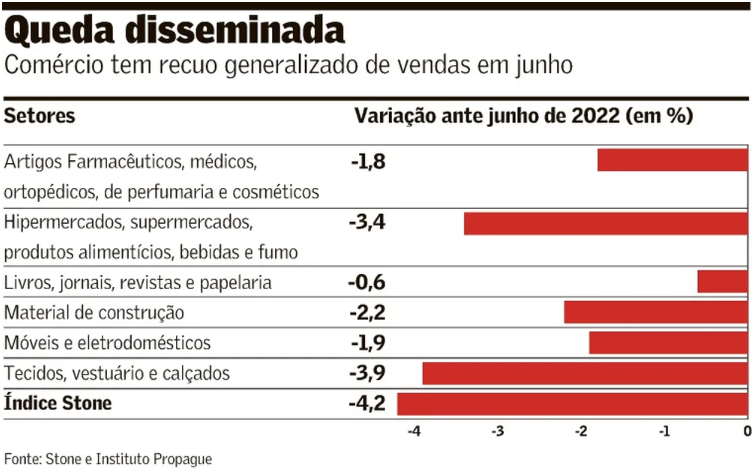
Na evolução do indicador por setores, todos os segmentos tiveram queda de vendas em junho, ante igual mês do ano passado. “O único setor que se manteve relativamente bem ao longo do ano foi artigos farmacêuticos” acrescentou. Ele frisou que as famílias, de maneira geral, não podem deixar de comprar medicamentos. “Mas móveis, eletrodomésticos, esses produtos mais caros sofreram nas vendas”, acrescentou.
No caso do desempenho do comércio no semestre, o especialista explicou que as vendas do varejo, de janeiro a junho, foram influenciadas por um “cenário macroeconômico muito negativo” no país. “Estamos com taxas de inadimplência muito altas e renda das famílias comprometida com [pagamento de] serviço de dívida”, lembrou ele. No entendimento do pesquisador, esse contexto acabou sendo desfavorável ao varejo, pois inibe novas compras – o que se refletiu na queda semestral do indicador da Stone.
Veja maisA startup americana Varda Space Industries enxerga o desenvolvimento de medicamentos no espaço como a aposta do futuro da indústria farmacêutica. A empresa, espécie de plataforma de fabricação orbital que entrega produtos de volta à Terra, acaba de anunciar o sucesso da cristalização do medicamento ritonavir feita no interior do satélite W-Series 1.
O ritonavir é tradicionalmente utilizado para o tratamento do HIV e, mais recentemente, foi incluído no medicamento antiviral Paxlovid, da Pfizer, para combater a Covid-19. O dispositivo estava acoplado à plataforma Photon, da empresa Rocket Lab.
O satélite foi lançado ao espaço no início de junho por um foguete Falcon 9, da SpaceX, de Elon Musk. Após algumas semanas de testes, a Varda iniciou o experimento de produção do medicamento, com 27 horas de duração. O procedimento foi concluído no dia 30 de junho.
Se o ritonavir fosse produzido na Terra, a gravidade poderia afetar a formação dos cristais em sua estrutura. Já na microgravidade, as estruturas cristalizadas se formam mais rapidamente e com maior qualidade. Agora, a empresa está se preparando para a reentrada da cápsula com os medicamentos, que deve acontecer a partir do dia 17 de julho.
Veja mais